The Semi-Truck Preventive Maintenance Checklist: Oil, Tires & Brakes
Ask a veteran owner-operator what keeps a truck profitable, and you'll rarely hear a story about a dramatic roadside rescue. You'll hear about routine — the boring, repeatable habits that keep a rig out of the shop and on the road. Preventive maintenance (PM) is exactly that: a scheduled, proactive look at the systems most likely to fail, done before they fail. For a semi that earns its keep by the mile, PM isn't an expense — it's insurance against the far bigger cost of unplanned downtime.
The three systems that cause the most breakdowns and the most out-of-service violations are the same three you rely on every single mile: the engine and its oil, the tires, and the brakes. Get those right on a regular cadence and you eliminate the majority of preventable failures. Here's a practical preventive-maintenance checklist for each — the kind of routine F1 Fleet Maintenance runs for owner-operators and fleets across McDonough, Atlanta, and the surrounding areas.
Why Preventive Maintenance Beats Reactive Repair
Reactive maintenance — waiting until something breaks — always looks cheaper until it isn't. A blown tire on I-285 doesn't just cost a tire; it costs a service call, lost hours, a possible missed appointment, and sometimes damage to the wheel well, air lines, or fenders. A skipped oil change doesn't just shorten engine life; it can turn into a five-figure rebuild. PM flips that math. By replacing wear items on a schedule and catching small problems while they're still small, you trade unpredictable, expensive emergencies for predictable, affordable upkeep — and you keep control of when the truck is down.
The Oil & Engine Checklist
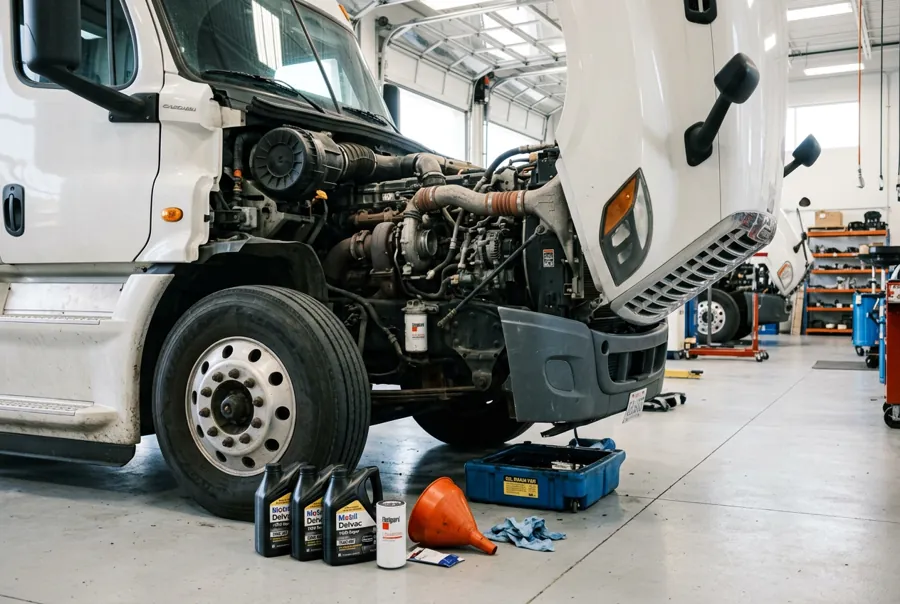
Clean oil is the single cheapest thing you can do to protect the most expensive component on your truck. Make the engine bay part of every PM visit.
- Change oil and filter on schedule. Follow the OEM interval for your engine and duty cycle. Long-haul highway miles and heavy stop-and-go work call for different intervals — know yours and stick to it.
- Check level and condition between changes. Pull the dipstick during your pre-trip. Milky, gritty, or fuel-diluted oil is a warning worth investigating before your next load.
- Inspect for leaks. Look for drips and seepage around the pan, filter, and seals. A small leak found early is a wipe and a gasket; ignored, it becomes a roadside shutdown.
- Service the air and fuel filters. A clogged air filter starves the engine and kills fuel economy; a neglected fuel filter can leave you stranded on the shoulder.
- Watch coolant, belts, and hoses. Check coolant level and condition, and inspect belts and hoses for cracks, glazing, and fraying while the hood is up.
The Tire Checklist
Tires are your only contact with the road, one of your biggest recurring expenses, and a component the DOT checks closely. A few minutes here prevents the most dramatic — and dangerous — failures on the highway.
- Check inflation cold, every day. Under-inflation builds heat and is the number-one cause of blowouts; over-inflation wears the center and rides rough. Use a quality gauge, not a boot or a tire thumper.
- Measure tread depth. Steer tires and drive/trailer tires have different legal minimums. Replace before you hit the limit, not after an inspector finds it.
- Look for irregular wear. Cupping, feathering, or one-sided wear points to alignment, balance, or suspension issues that will chew through your next set too.
- Rotate on schedule. Rotating evens out wear and stretches the life of the entire set — real money over the life of the truck.
- Inspect for damage. Cuts, bulges, exposed cords, and embedded debris are all reasons to pull a tire before it pulls itself apart at 65 mph.
The Brake Checklist
Brakes top the list of out-of-service violations for a reason — they wear constantly and drift out of spec. Build a proper brake check into every PM visit.
- Measure lining and pad thickness. Compare against the legal minimum and replace proactively; a lining near the limit is one hard stop from a violation.
- Check pushrod travel and slack adjusters. Confirm the brakes are in adjustment. A slack adjuster that's stopped adjusting quietly pushes a brake past its stroke limit.
- Inspect drums and rotors. Look for heat cracks, deep scoring, and glazing — all obvious defects an inspector spots in seconds.
- Test the air system. Verify build-up time, governor cut-in/cut-out, air-loss rate, the low-air warning, and the tractor-protection valve.
- Check for contamination and ABS faults. A leaking wheel seal on the friction surface is an automatic violation, and a lit ABS lamp will be written up.
Don't Forget the Walkaround
A complete PM is more than the big three. While you're under and around the truck, check lights and reflectors, wipers and washer fluid, the fifth wheel and kingpin, suspension and air bags, steering play, the battery and its connections, and every fluid level. Most of these take seconds — and they're exactly what a DOT inspector looks at first.
A good rule of thumb: if it turns, carries load, or helps you stop, it belongs on your preventive-maintenance checklist.
How Often Should You Run It?
Daily pre-trip and post-trip inspections cover the visual and safety basics the law requires. Beyond that, most operators run a more thorough PM on a mileage or time interval — commonly every few thousand miles, or monthly for high-mileage trucks — with oil, tires, and brakes checked every visit and deeper service like brake relines or tire replacement scheduled as wear dictates. For fleets, standardizing that interval and logging every check is what keeps CSA scores clean and equipment predictable. The exact numbers matter less than the discipline of never skipping.
Let the Shop Come to You
The reason PM gets skipped is almost always the same: nobody wants to lose a day driving to a shop and sitting in a waiting room. Mobile maintenance removes that excuse entirely. F1 Fleet Maintenance performs oil changes, tire service, and brake work on-site — at your yard, a truck stop, or wherever the rig is parked across McDonough, Atlanta, and the surrounding areas. Your PM happens on your schedule, with no deadhead miles and no queue, while you rest, load, or handle paperwork.
Preventive maintenance isn't glamorous, but it's the difference between a truck that earns and a truck that surprises you. Keep clean oil in the engine, good rubber on the road, and brakes in spec, and you'll spend far less time — and money — dealing with the failures that strand less-disciplined operators. Build the routine, and let us bring it to you.
Book a mobile brake inspection
We come to your yard, truck stop, or roadside across metro Atlanta — DOT-ready brake service with no shop trip and no downtime.